3 Ways to Increase Fund Administration Efficiency with AI
Three practical AI upgrades for fund administration: agents that standardize broker data, strike the NAV into Paxus or Geneva, and handle counterparty communication.
Fund administration efficiency is not a tooling problem. The tools exist. The bottleneck is the human work between them, and that is exactly what AI agents remove.
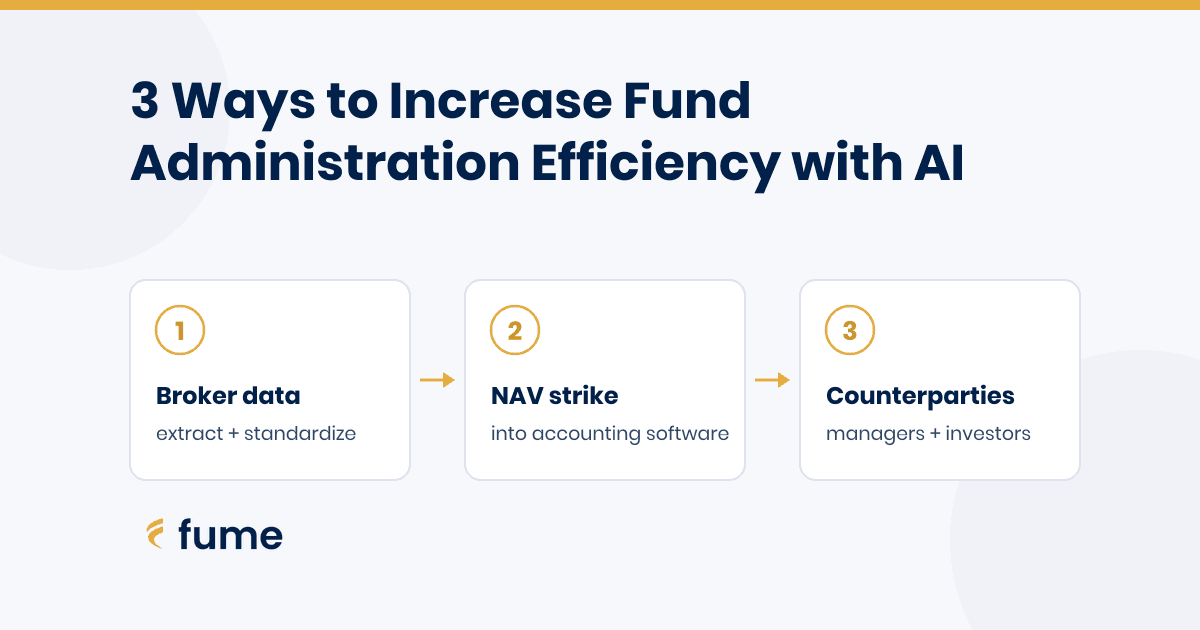
The three highest-leverage ways to increase fund administration efficiency with AI are: deploy an agent that extracts data from your brokers and formats every transaction to a single standard, let an agent strike the NAV and load the results into your accounting software, and hand routine counterparty communication to an agent with your team reviewing before anything goes out. All three attack the same bottleneck: people copying data between systems that do not talk to each other. Below is what each one looks like in practice, and how to put it in place without risking a client deliverable.
Where the hours actually go
Based on Fume analysis from direct discussions with fund administrators, a typical NAV cycle consumes five or more hours of manual data work per fund, spread across twenty or more data formats that have to be re-keyed before any check can run. More than half of team time goes to gathering data rather than judging it. None of that time is spent on the work clients pay an administrator for: accuracy, oversight, and sign-off.
The client side has already moved. Mercer's global manager survey found 91% of investment managers using or planning to use AI in their investment process. Managers who run AI internally will expect their administrator to keep pace, and they notice when a competitor closes NAVs in hours instead of days.
1. Extract broker data with an agent and standardize every transaction
Every broker, bank, and custodian reports differently: PDFs, CSVs, portal exports, emailed confirmations, each with its own columns, conventions, and quirks. Today a person downloads each file, opens it, and re-keys or reshapes it into the layout the operations platform expects. It is the highest-volume, lowest-judgment work in the shop.
An agent does this end to end. It logs into the broker portals, pulls statements and confirmations from the inbox, reads each source in whatever format it arrives, and outputs every transaction in one standard layout, the one your own process already uses. New broker, new format, changed PDF: the agent reads it the way a human operator would, which is precisely where scripted automation always broke. We compared the tool categories in detail in AI agents vs. chatbots vs. RPA in fund administration.
The efficiency gain is not only the extraction hours. Once every transaction lands in one standard, everything downstream, reconciliation, NAV preparation, and reporting, starts from clean data instead of a format-conversion backlog.
2. Strike the NAV with an agent and load it into your accounting software
With standardized transactions in hand, the next agent carries the cycle through to a struck NAV. It enters positions and transactions into the accounting platform you already run, whether that is Paxus, Geneva, or another system of record, runs completeness and tolerance checks against the prior period, computes the NAV inside your existing engine, and delivers the result with its supporting pack to the accountant's inbox. Nothing is migrated and nothing is replaced; the agent operates the same software your team operates today.
In production this looks like an agent that starts before the team logs in: it pulls the overnight broker reports, files the statements, structures the trades, posts them to the accounting software, and has a draft NAV per unit waiting for review by 07:00. The accountant's job shifts from producing the number to checking it.
The human stays in charge of sign-off, and regulators expect exactly that. FINMA Guidance 08/2024 requires supervised institutions to assign clear responsibility for each AI application and to test and monitor it continuously, and ESMA's guidance on AI in investment services makes the firm responsible for outcomes regardless of the tooling. A well-run agent deployment satisfies both with a run log and a named owner. For the full pipeline, from statement collection to checks and escalation, see our deep dive on automating NAV calculation with AI agents.
3. Let an agent handle routine counterparty communication
A fund administrator sits between the investment manager on one side and investors on the other, and a large share of the day is correspondence: chasing the manager for a missing trade file, confirming a subscription, answering an investor's question about their statement, sending the monthly NAV notice. Each message is short; the volume is what costs the hours.
An agent handles the routine layer. It drafts replies from live system data rather than memory, so the numbers in the message match the books. It chases counterparties for missing inputs on schedule instead of when someone remembers. It files inbound correspondence against the right fund and investor. And your team reviews before anything leaves the building, because unreviewed investor communication has no place in a regulated deliverable. What stays human is everything non-routine: judgment calls, complaints, and anything a reasonable operator would escalate.
How to put this in place
- Start with one process, usually broker data extraction. It has the most hours and the least judgment, and errors are caught by the reconciliation controls you already run.
- Run the agent in shadow mode. For a few NAV cycles it works in parallel with the existing manual process while you measure the disagreement rate instead of assuming it.
- Promote it, then add the next agent. First the team approves every output, then only exceptions. Once the first agent is stable, the NAV and communication agents follow the same path.
We wrote a dedicated adoption path for administrators in AI agents for fund administrators, and if you want the foundations first, our pillar guide explains AI agents in fund operations from first principles.
How Fume helps
Fume builds, runs, and maintains exactly these agents for fund administrators. We map your manual processes, deploy a dedicated agent connected to the tools you already use, and operate the fleet with a watchdog on every run, so your team reviews output instead of producing it. The first agent is live in production within 30 days, on a monthly subscription priced well below the manual labor it replaces. Nothing to integrate, nothing to migrate, no new IT hires.
If you want to see which of your processes an agent should take over first, book a call and we will map it with you, or write to us at info@fume.finance. You can also explore what our AI agents for funds do day to day.