AI Agents vs. Chatbots vs. RPA in Fund Administration
A chatbot answers questions, RPA replays scripts, an AI agent completes the task end to end. What each does, where it breaks, and which job belongs to which tool.
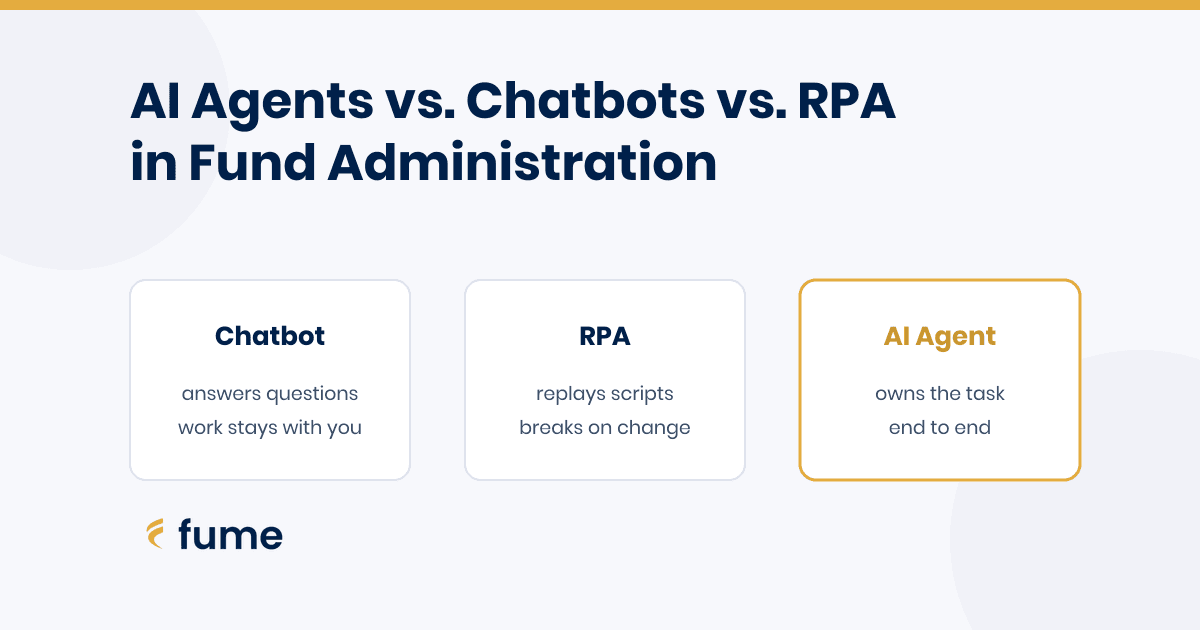
Three technologies get called "AI" in fund administration, and they behave nothing alike. What each one actually does, where it breaks, and which task belongs to which tool.
The short version: a chatbot answers questions while the work stays with your team. RPA (robotic process automation) replays a scripted sequence of clicks and breaks when the input changes. An AI agent owns a task end to end, adapts to messy input, and hands your team a finished result to review. All three have a place in a fund administration operation, but they are not interchangeable, and buying one when you need another is how automation projects fail.
Chatbots: useful, but the work stays with you
ChatGPT, Copilot, and the assistants embedded in office suites are genuinely useful for fund teams. They summarize documents, draft emails, and explain unfamiliar regulation. What they do not do is complete operational work, because they have no access to your systems and no mandate to act.
An analyst can paste a broker statement into a chatbot and ask for the transactions in a table. That saves minutes. But the analyst still logged into the portal, downloaded the statement, pasted the output into the admin platform, and checked it. The task ownership never moved. Multiply that across every statement, every day, and the team's week looks the same as before, just with better drafts.
RPA: fast until the format changes
RPA had a real run in fund administration through the 2010s. Bots log into portals, click through screens, copy fields, and paste them elsewhere. When the input is identical every time, this works and it is cheap to run.
The weakness is brittleness. An RPA bot follows coordinates and templates. When the custodian redesigns its portal, or a broker adds a column to the statement, or a PDF arrives scanned instead of native, the bot stops or, worse, keeps going and captures the wrong field. Every format change becomes a maintenance ticket. Operations teams that adopted RPA at scale often ended up with a second team maintaining the bots.
AI agents: task ownership with adaptive input handling
Anthropic's engineering guidance draws the line precisely: workflows orchestrate a model through predefined code paths, while agents are systems where the model directs its own process and tool use to accomplish a task. Production deployments in fund operations usually combine the two, a defined pipeline with adaptive steps inside hard guardrails.
The property that matters for fund administration is tolerance for input variety. The same agent can process a native PDF, a scanned statement, a CSV, and a forwarded email in one run, because it reads content rather than coordinates. When a broker changes its layout, the agent keeps extracting the same economic facts. That single property removes the maintenance burden that killed most RPA programs.
The second property is task completion. An agent connected to your systems does not produce a draft for someone to re-key. It pulls the statement, structures the transactions, loads them into the NAV platform, runs tolerance checks, and posts the exceptions to a human queue. The team reviews output instead of producing it.
Side by side
| Chatbot | RPA | AI agent | |
|---|---|---|---|
| Owns the task | No, assists a person | Yes, for one rigid path | Yes, end to end |
| Messy input | Handles it, manually fed | Breaks | Handles it |
| System access | None | Screen level | APIs, files, portals, chain |
| When formats change | Person adapts | Maintenance ticket | Agent adapts |
| Audit trail | Chat history | Bot logs | Full run log per task |
| Oversight model | Person is the control | Exception alerts | Checks, limits, approval steps |
Which tool for which job
- Keep chatbots for research, drafting, and explaining. They are the cheapest productivity gain available and require no integration.
- Keep RPA where it already works: stable internal systems, unchanging screens, high-volume identical transactions. Replacing working RPA has no payoff.
- Deploy agents where input variety and volume meet: statement ingestion, transaction capture, NAV input preparation, onboarding document processing, report drafting from live data. These are the processes where teams burn hours precisely because the input never arrives the same way twice.
Oversight applies to all three
Regulators do not distinguish by technology label. ESMA's 2024 statement on AI in investment services makes firms responsible for outcomes regardless of the tool, with testing, monitoring, and record-keeping proportionate to the risk. FINMA's Guidance 08/2024 expects an inventory of AI applications with clear ownership. An agent that logs every run is easier to defend in that framework than a person doing the same task with no trail at all.
For the full picture of where agents fit across the fund lifecycle, from data ingestion to tokenized share issuance, read our complete guide to AI agents for fund operations. And if you want to see what a delivered, managed agent looks like in practice, that is exactly what we build at Fume.