AI Agents for Fund Operations: The Complete Guide
What AI agents are, what they take over across the fund lifecycle (NAV, onboarding, compliance, reporting), what FINMA and ESMA expect, and how to deploy them.
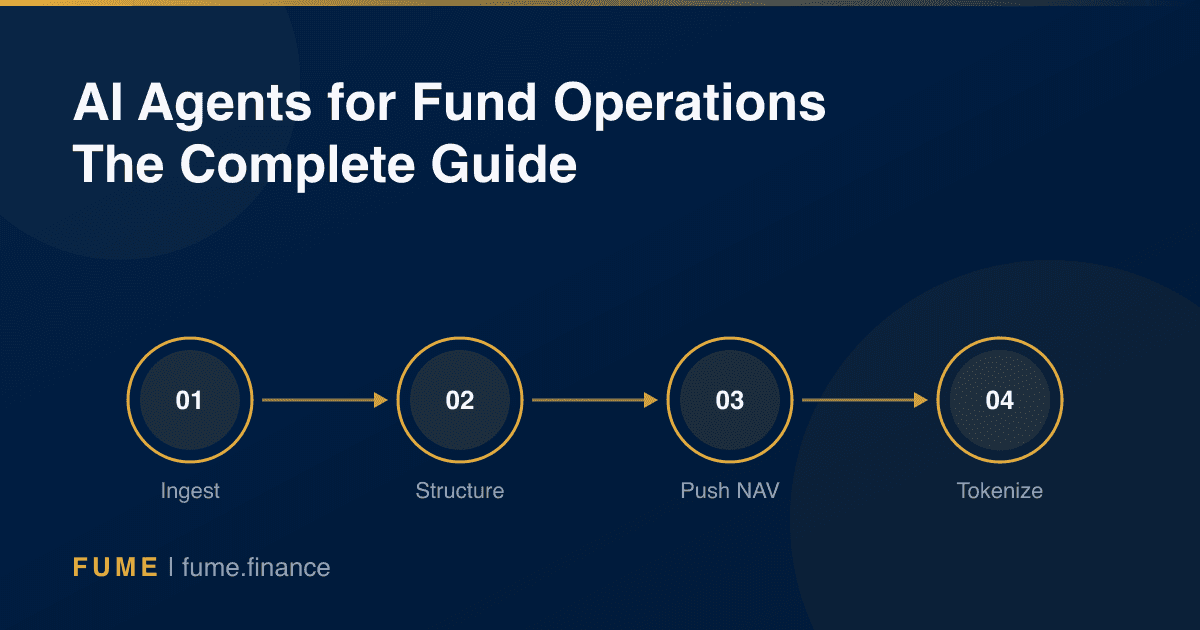
What AI agents are, what they can take over across the fund lifecycle, what regulators expect, and how funds and administrators actually deploy them. The complete guide.
An AI agent for fund operations is a software system that completes an operational task end to end: it pulls the data, processes it, pushes the result into the systems the fund already runs, and logs every step for review. That is the difference from a chatbot, which answers questions while the work stays with your team, and from classic automation scripts, which break the moment a broker changes a statement format. Agents built on large language models can read messy, inconsistent inputs and still produce the structured output your platform expects.
Fund operations happens to be one of the best environments for this technology. The work is repetitive, high volume, and deadline driven. The inputs arrive in dozens of formats from custodians, brokers, banks, and blockchains. And almost every step is currently done by a person copying data from one system into another. This guide covers what agents are, where they fit in a fund, what supervisors like FINMA and ESMA expect, and how to get started without betting the operation on it.
What is an AI agent, precisely?
The clearest definition comes from Anthropic's engineering guide on building effective agents: agents are systems where a large language model directs its own process and tool usage, deciding how to accomplish a task rather than following a fixed script. A workflow, by contrast, orchestrates the model through predefined steps. Most production systems in fund operations are somewhere on that spectrum: a defined pipeline with agentic steps inside it, wrapped in hard guardrails.
In practice, an agent deployed inside a fund has three things a chatbot never gets:
- Access to the systems where the work happens: the admin platform, the custodian portal, the email inbox, the NAV engine, the blockchain.
- A defined task with a measurable output: "every morning, turn yesterday's broker statements into structured transactions in the format Paxus expects."
- Permission to complete it, inside limits: tolerance checks, approval steps for anything unusual, and a full log of every action taken.
If you want the full comparison between these tool categories, we wrote a dedicated breakdown: AI agents vs. chatbots vs. RPA in fund administration.
Why fund operations, and why now
Adoption in asset management is no longer a fringe topic. Mercer's 2024 global survey of investment managers found that 91% of managers are either already using AI (54%) or planning to use it (37%) within their investment strategy or research. The operations side is following the same curve, because that is where the measurable hours are.
Think about where the time goes in a typical fund back office. Someone logs into five broker portals every morning and downloads statements. Someone re-types positions into the admin platform. Someone reconciles breaks between the custodian file and the internal ledger. Someone drafts the same investor update structure every quarter. None of this is judgment work. All of it is format translation and data movement, which is exactly what language models became good at.
Two structural shifts make agents viable now where earlier automation failed:
- Tolerance for messy input. Robotic process automation (RPA) needed every input pixel-perfect. An agent can receive a PDF statement, a CSV export, and a forwarded email in the same run and normalize all three.
- Machine-readable fund infrastructure. As funds tokenize shares and settle in stablecoins, the fund itself becomes something software can operate directly. An onchain fund exposes its cap table, NAV history, and flows as data. We covered that foundation in Tokenized fund vs. on-chain fund.
What agents take over across the fund lifecycle
Data ingestion and transaction capture
The agent logs into broker, bank, and custodian sources, pulls statements and confirmations, reads onchain transactions where relevant, and turns everything into structured records. This is usually the first process worth automating because it is pure volume with zero judgment.
NAV production
Agents do not replace the NAV engine. They automate the work around it: collecting the inputs, normalizing them, loading them into Paxus, NTAS, Geneva, or an onchain NAV engine, and running completeness and tolerance checks before a human signs off. We wrote a full deep dive on this: Automating NAV calculation with AI agents.
Investor onboarding and communications
Agents pre-process subscription documents, extract KYC data for the compliance team, draft investor updates and DDQ responses from approved sources, and answer routine investor questions with a human reviewing before anything leaves the building.
Compliance and risk monitoring
An agent can watch regulatory feeds across jurisdictions, flag portfolio concentration and exposure limit breaches, and check that every fund action stays inside the mandate. It never gets bored on day 400 of watching the same limits.
Document processing
Term sheets, side letters, fund documents, and audit requests all follow patterns. Agents extract the terms that matter, compare versions, and flag deviations for legal review.
For a ranked view of which agents deliver the most value per process, see our guide to the best AI agents for funds.
A concrete example: the NAV lifecycle as an agent chain
The way we deploy this at Fume is a chain of four narrow agents rather than one monolithic system:
- Ingest agent. Pulls data from brokers, banks, inboxes, and onchain sources every morning. Manual logins and exports disappear.
- Structure agent. Converts any statement format into structured transactions, across crypto and traditional assets, in the exact layout the target platform expects.
- Push agent. Loads the structured data into the NAV engine, retrieves the calculated NAV, fees, and cap table, and runs sanity checks against the prior period.
- Tokenize agent. Feeds the results into the fund's onchain layer, so tokenized shares, payouts, and the unit register stay current. This last step runs on Fume's tokenization engine, which issues fund shares under the ERC-6909 token standard and is callable end to end by software.
Narrow agents beat broad ones for a simple reason: each one has a testable output, so you can measure error rates per step and put a human checkpoint exactly where the risk sits.
What regulators expect when funds use AI
Supervisors have already published their expectations, and they are workable if you design for them from the start.
In Switzerland, FINMA's Guidance 08/2024 on governance and risk management when using artificial intelligence, published in December 2024, expects supervised institutions to maintain an inventory of AI applications, assign clear responsibility for them, manage model risks such as robustness and explainability, and test and monitor systems on an ongoing basis, including fallback mechanisms.
In the EU, ESMA's public statement on the use of AI in investment services (May 2024) reminds firms that MiFID II organisational and conduct requirements apply fully when AI is in the loop: firms remain responsible for outcomes, must test and monitor proportionately to the risk, and must keep records documenting how AI is used, including data sources and modifications over time.
The practical translation for fund operations: every agent needs an owner, a log of every run, defined limits on what it may do alone, and a human approval step wherever an error would reach an investor or a regulator. This is also why "agent" does not mean "unsupervised." A well-designed deployment produces more audit trail than the manual process it replaced, not less.
Build, buy, or have it managed
There are three routes to getting agents into production:
| Route | What it looks like | Where it fits |
|---|---|---|
| Build in-house | Your own engineers build on model APIs and maintain the agents | Large administrators with standing engineering teams and many funds to amortize the cost across |
| Buy software | Off-the-shelf AI features inside your existing platforms | Generic tasks like document summarization; rarely covers your specific process end to end |
| Managed agents | A specialist builds the agent around your exact process, wires it into your systems, and operates it | Funds and administrators who want the outcome without hiring an AI team |
The managed route is what we offer through AI agents for funds: we find the process that consumes the most hours, build the agent around it, deploy it into the existing stack, and monitor every run. No migration and no new software for the team to learn.
If you run a fund administration business and are weighing how to introduce agents across client funds, we wrote a practical adoption path for that specific case: AI agents for fund administrators.
How to start without betting the operation
- Pick one process, not a program. Choose the task with the most hours and the least judgment. Statement ingestion and transaction capture usually win.
- Run in shadow mode first. The agent produces its output in parallel with the existing manual process. Compare daily until the error rate is measured, not assumed.
- Move to assisted, then autonomous. First the human approves every output, then only exceptions, then the agent runs and the human reviews summaries.
- Keep the logs. Your auditor and your regulator will ask. A good agent deployment answers with a complete run history.
Note what is missing from that list: a company-wide tool rollout. Handing every analyst a chatbot license changes an adoption dashboard, not the NAV cycle, and we explain the difference in why AI adoption is not AI automation in fund operations.
If you want this sequencing applied to the three processes with the fastest payback, broker data extraction, NAV production, and counterparty communication, we laid it out in 3 ways to increase fund administration efficiency with AI.
The funds and administrators that adopt this earliest will not look dramatically different from the outside. They will simply close their NAVs faster, onboard investors with less friction, and run leaner teams on the same volume. The manual back office does not survive contact with programmable money and software that can read.
Want to know which of your processes an agent should take over first? Book a call and we will map it with you.