Automating NAV Calculation with AI Agents
AI agents don't replace the NAV engine. They automate statement collection, transaction structuring, data loading, and checks, so the team reviews instead of typing.
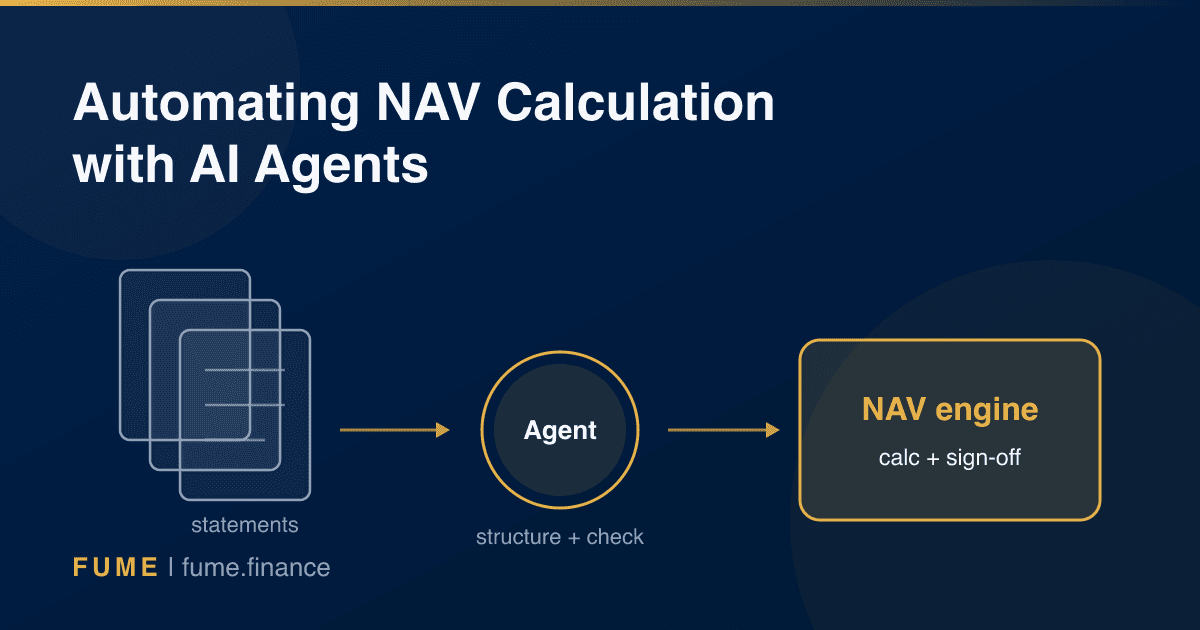
AI agents do not replace your NAV engine. They take over the manual work around it: collecting statements, structuring transactions, loading data, and checking the result before a human signs off.
Can NAV calculation be automated with AI? Yes, but not where most people first look. The calculation itself, assets minus liabilities divided by units outstanding, has been automated for decades inside platforms like Paxus, NTAS, Geneva, and Investran, and more recently inside onchain NAV engines. What has never been automated is everything before and after the calculation: pulling statements from a dozen sources, re-typing positions into the platform, chasing missing files, reconciling breaks, and distributing the result. That surrounding work is where a NAV team's hours actually go, and it is exactly the work AI agents now take over.
Where the hours really go in NAV production
Ask any fund accountant to walk through a NAV cycle and the pattern repeats:
- Collection. Log into broker portals, custodian sites, and bank platforms. Download statements. Check the inbox for the counterparties that still email PDFs. For crypto funds, pull transactions from exchanges and blockchains.
- Transcription. Convert every one of those formats into the layout the accounting platform expects, mostly by hand or with fragile spreadsheet macros.
- Loading and reconciliation. Import the data, find the breaks between sources, chase the explanations.
- Distribution. Once the NAV is signed off, update the investor portal, the transfer agent records, fee calculations, and any tokenized share register.
The calculation in the middle takes minutes. The choreography around it takes days, which is why monthly NAVs are still the norm for funds whose investors would prefer weekly or daily. We compared the two operating models in detail in Traditional vs. on-chain NAV calculation.
The agent pipeline: four narrow agents, one NAV cycle
The deployment pattern that works is a chain of specialized agents, each with one testable job:
- Ingest agent. Every morning it pulls data from brokers, banks, email inboxes, and onchain sources. It knows which files are expected and flags anything missing instead of letting the gap surface at month-end.
- Structure agent. It converts any statement format, native PDF, scan, CSV, or email body, into structured transactions in the exact layout the accounting platform expects, across both traditional and digital assets. This step is where language models changed the economics: the agent reads content, so a broker changing its statement layout does not break the pipeline.
- Push agent. It loads the structured data into the NAV engine, triggers the calculation, and retrieves NAV, fees, and the cap table. Before anything moves on, it runs completeness checks (all expected sources present) and tolerance checks (NAV movement versus prior period inside defined bands). Exceptions go to a human queue.
- Distribute agent. Once signed off, it pushes the results wherever they need to live. For tokenized funds, that means updating the onchain register through Fume's tokenization engine, so the ERC-6909 share register, payouts, and NAV history stay current without anyone re-keying anything.
Note what is absent: no agent computes the NAV. The engine your auditors already trust does that. The agents feed it and carry its output, which keeps the control framework intact.
The crypto and tokenized fund case
Digital asset funds feel this problem hardest. Positions live across exchanges, custodians, DeFi protocols, and self-custodied wallets. Stablecoin subscriptions arrive onchain at any hour. Traditional admin platforms were not built to read any of that, so the manual translation layer is even thicker than in a conventional fund.
Agents fit naturally here because onchain data is machine-readable by default. An ingest agent reads wallet transactions directly rather than scraping a portal, and a distribute agent writes the confirmed NAV back onchain. For funds that operate fully onchain, the loop closes completely: subscriptions, NAV recording, fee extraction, and share issuance all settle programmatically, with the agent chain bridging whatever off-chain assets remain.
Controls: what your auditor will ask
Automating NAV inputs concentrates risk if it is done without controls, so the controls are not optional extras, they are the design:
- Four-eyes stays. The agent prepares, a person approves. The sign-off that your fund documents require does not move to software.
- Tolerance bands catch drift. Any movement outside defined thresholds stops the pipeline and escalates.
- Every run is logged. Which files were read, what was extracted, what was loaded, what checks ran. FINMA's Guidance 08/2024 expects exactly this: inventoried AI applications, clear responsibility, and ongoing testing and monitoring with fallback mechanisms. A manual process rarely produces this much evidence.
- Valuation judgment stays human. Pricing an illiquid token or a side-pocketed position is a judgment call. Agents assemble the inputs for that call; they do not make it.
What changes when the pipeline runs itself
The immediate effect is time: a NAV cycle that consumed days of collection and transcription compresses to review and sign-off. The second-order effect is frequency. When producing a NAV no longer costs a week of work, weekly or even daily NAVs become affordable for funds that could only justify monthly before. That matters commercially, because tokenized fund investors increasingly expect NAV cadence closer to what they see onchain.
This article covers one process deeply. For the full map of what agents take over across ingestion, onboarding, compliance, and reporting, start with our complete guide to AI agents for fund operations. And if your NAV cycle is the process eating your team's week, this is the first agent we usually build.