AI Adoption Is Not AI Automation: What Actually Speeds Up Fund Operations
Giving your operations team AI licenses does not shorten the NAV cycle. Where agents already match a human operator, and what to report instead of adoption.
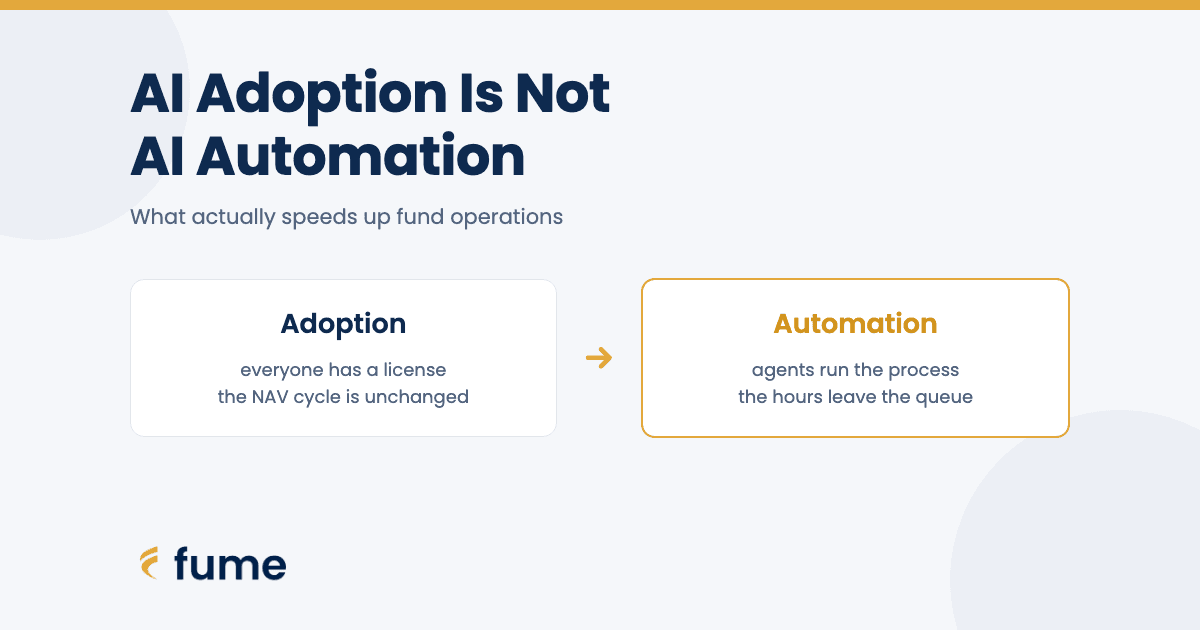
Buying AI licenses for a fund operations team is not the same as automating fund operations. One changes a dashboard. The other changes the NAV cycle.
Handing your operations team a chatbot will not shorten the NAV cycle. It makes a small group of people faster at the parts of the job they were already good at, and leaves everyone else working exactly as before. Work only speeds up when a task leaves the human queue completely, which is what an autonomous agent does and a chatbot cannot. Whether that happens, rather than how many licenses you bought, decides if AI ever shows up in your operating numbers.
Every rollout produces the same barbell
The pattern repeats often enough to plan for. In AI Adoption is a Myth, Vasuman Moza, CEO of Varick Agents, describes what he sees after enterprise AI rollouts of every size: roughly 5 to 10% of staff become genuine power users, about 20% use the tool occasionally and badly, and around 70% barely touch it. The adoption dashboard goes green while the throughput of the business stays where it was.
The industry numbers agree. McKinsey's State of AI survey, published in November 2025 across nearly 2,000 respondents in 105 countries, found 88% of organizations regularly using AI in at least one business function. Only 39% could attribute any EBIT impact to it, and most of those put the contribution below 5%. Almost everyone is using it, and almost nobody can find it in the accounts.
For a fund administrator or a ManCo this matters more than it does for a software company. The constraint here is not creativity. It is a recurring, deadline-bound production cycle staffed by people who did not sign up to become AI engineers.
Using AI and using it well are different skills
An operations analyst can paste a broker statement into a chatbot and get a clean transaction table back in seconds. That works, and it saves a real half hour.
Doing it well is a different skill. It means knowing which step of the cycle genuinely needs a model's judgment and which part should stay deterministic code. It means recognizing the confidently wrong answer, and checking the output against the custodian record before it reaches the books. Most people on most teams never get there, and there is no reason they should. They were hired to produce a NAV, not to become prompt engineers.
Meanwhile the analyst still logged into the portal, downloaded the file, pasted the result into the accounting platform, and reconciled it. The chatbot helped with one step out of six, and the task still belongs to a person. We drew the line between the tool categories in AI agents vs. chatbots vs. RPA in fund administration.
Where agents already match a human operator
The useful question is not whether AI is as capable as your team in general. It is whether one agent, on one narrow task, produces the same result as the person who does that task today. On the repetitive layer of fund operations, that bar is now met routinely:
- Collecting inputs. Logging into broker and custodian portals, pulling statements out of the inbox, filing them against the right fund.
- Structuring transactions. Reading a PDF, CSV, or portal export in whatever layout it arrives and emitting transactions in the one format your platform expects.
- Loading and checking. Posting positions into Paxus, Geneva, NTAS, or Investran, running completeness and tolerance checks against the prior period, and raising the breaks.
- Routine correspondence. Chasing a missing trade file, confirming a subscription, drafting the monthly NAV notice from live system data.
What these tasks have in common is that the right answer can be checked. A transaction either matches the custodian record or it does not. That is what makes a claim about human quality measurable rather than promotional, and it is why the honest test is a shadow run: the agent works in parallel with the existing manual process for a few cycles, and you count the disagreements instead of assuming them. If the agent and the analyst produce the same output, the task is ready to leave the human queue. If they do not, you have found either a weak agent or an undocumented rule, and both are worth finding.
Judgment work is a different matter, and it is not what we are proposing to automate. Valuing an illiquid position, deciding whether a break is material, and signing the NAV stay with your team.
Put the agent in the system of record, not in front of the analyst
If most of a team will never become skilled prompters, then the automation cannot depend on them prompting. It has to run without being asked, inside the systems they already work in.
In practice that means the agent starts before the team logs in. It pulls the overnight broker reports, structures the trades, posts them to the accounting platform, runs the checks, and leaves a draft NAV and an exception list waiting at 07:00. The analyst's day starts at review instead of at data entry, and nothing about their interface changed. They approve, reject, or correct.
The economics are different too. A license rollout costs the same whether or not anyone uses it well. An agent is measured against the hours it removes from one specific process, so it either pays for itself or it gets switched off. Our breakdown of the agents worth deploying first ranks them on that basis.
Stop reporting adoption. Report the share of work that is automated.
Adoption metrics flatten a spectrum into a yes or a no. Whether a person logged in this month tells you nothing about whether the NAV closed faster. The number worth reporting is the composition of the work itself:
| Category | What it means | What to track |
|---|---|---|
| Manual | A person performs the task start to finish | Hours per NAV cycle, per process |
| Hybrid | A person performs the task with AI assistance | Hours saved, and how unevenly they are distributed across the team |
| Automated | An agent performs the task; a person reviews and signs | Share of runs approved without correction, and time to review |
Run that report every quarter per process, not per person. It survives staff turnover, it points at where the next agent belongs, and unlike a login count it only moves when something in the operation actually changed.
What stays human, and what regulators expect
Moving a task out of the human queue does not move the responsibility. FINMA Guidance 08/2024 expects supervised institutions to keep an inventory of their AI applications with a named owner for each, and to test and monitor them on an ongoing basis. ESMA's statement on AI in investment services holds the firm responsible for outcomes whatever tool produced them. Neither text cares whether a person, a script, or an agent did the work.
A background agent is easier to defend than the status quo in one respect: every run leaves a complete record of what was fetched, what was posted, and what was escalated. The manual version of the same task leaves an email trail and somebody's memory. If you are planning the sequencing, our practical adoption guide for fund administrators covers the path from shadow mode to production, and the pillar guide sets out everything AI agents handle across the fund lifecycle.
How Fume helps
Fume builds and operates these background agents for fund administrators, ManCos, and managers. We look at where the manual hours actually go, deploy an agent into the tools you already run, prove it in shadow mode against your existing process, and then run the fleet with a watchdog on every run. There is nothing to migrate, no new interface for your team to learn, and no requirement that anyone on the team becomes an AI expert.
The first agent is live in production within 30 days. To find out which of your processes should go first, book a 30-minute call or write to info@fume.finance. You can also browse what our AI agents for funds do day to day.