What Is a Transfer Agent? Role, Duties, and Cost
A transfer agent maintains the record of who owns what. The two meanings of the term, what the fund role covers, its cost drivers, and the on-chain alternative.
The term means two different things depending on whether you are talking about a listed company or an investment fund. This covers both, then goes deep on the fund version.
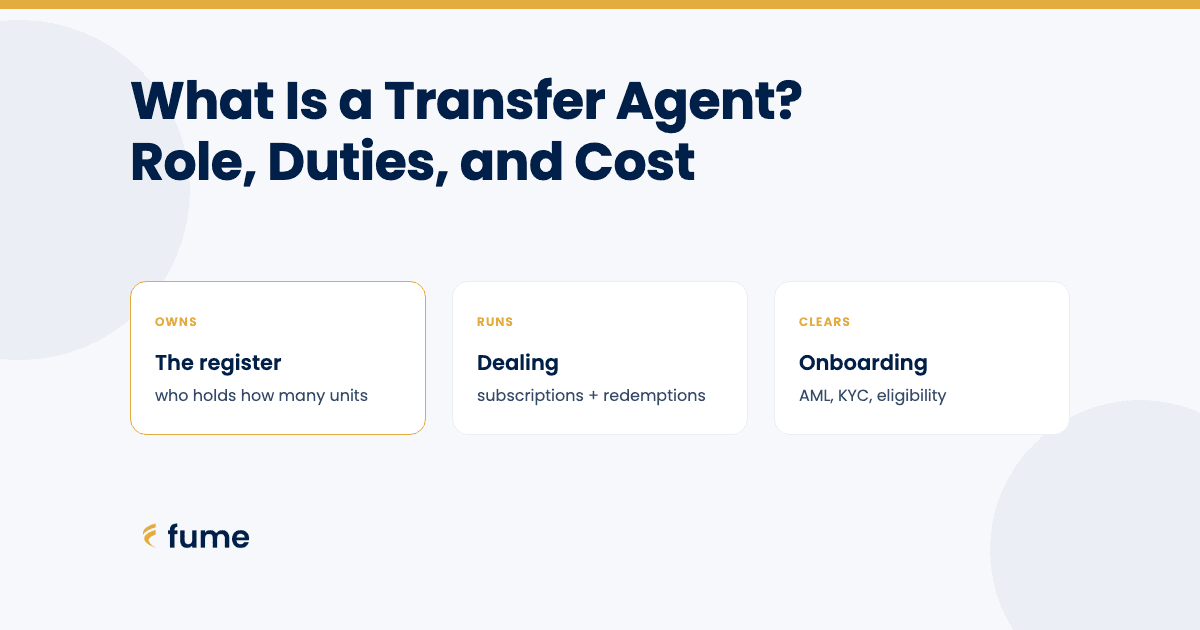
A transfer agent is the party that maintains the official record of who owns a security. It records subscriptions, processes transfers between holders, cancels units on redemption, and can state at any moment exactly how many units each investor holds. If there is a dispute about ownership, the transfer agent's register is the answer.
Everything else the role involves follows from that one responsibility.
Two meanings of the same term
Before going further it is worth separating the two contexts, because searching the term returns both and they are not the same job.
| Corporate transfer agent | Fund transfer agent | |
|---|---|---|
| Security | Shares of a listed or private company | Units or shares of an investment fund |
| Register of | Shareholders of the issuer | Investors in the fund |
| Also handles | Proxy voting, corporate actions, stock splits, lost certificates | Subscriptions, redemptions, AML and KYC onboarding, investor statements |
| In the US | Must register with the SEC under Section 17A of the Exchange Act | Usually performed by the fund administrator |
| Typically | A specialist registrar | An administrator, a registrar, or the depositary |
The common thread is the register. The difference is what sits around it: a corporate transfer agent spends its time on corporate actions and shareholder communications, while a fund transfer agent spends its time on investor onboarding and dealing.
The rest of this article is about the fund version.
What a fund transfer agent does
Maintains the register
The core deliverable. Every unit in issue is attributed to a named holder, and the register reconciles to the fund's total units outstanding at every valuation point. This is the record the auditor tests and the regulator asks for.
Processes subscriptions and redemptions
Dealing is the operational bulk of the job. The transfer agent receives orders against a dealing deadline, checks them for completeness and eligibility, applies the correct NAV once it is struck, issues or cancels the units, and confirms back to the investor. Miss a dealing cut-off and the order rolls to the next cycle, which is why this function is timetable-driven in a way the rest of fund administration is not.
Runs investor onboarding, AML and KYC
In most fund structures the transfer agent is the party that actually collects and tests investor identity documents, screens against sanctions lists, establishes source of funds, and refuses or delays subscriptions that do not clear. This is usually the slowest part of onboarding a new investor and the part most likely to be outsourced badly.
Services investors
Contract notes, periodic statements, distribution notifications, and answering the "how many units do I hold" question. Unglamorous, high-volume, and the part of the fund investors actually experience.
Supports reporting
The register feeds investor breakdowns for regulatory reporting, tax reporting such as FATCA and CRS classifications, and the concentration data managers need to know who their fund really depends on.
Transfer agent vs. paying agent vs. administrator
Three roles that overlap in practice and are often bought from the same provider, but which are legally distinct appointments:
- Transfer agent — owns the register. Knows who holds what.
- Paying agent — owns the cash out. Settles distributions and redemption proceeds to investors. See what a paying agent is.
- Fund administrator — owns the books. Strikes the NAV, keeps the fund accounts, produces financial statements.
They interlock on every redemption: the administrator strikes the NAV, the transfer agent cancels the units at that NAV, the paying agent sends the money. A failure in any one of the three shows up as the same symptom, an investor who has not been paid, which is why the boundaries between them are worth understanding before something goes wrong. Our comparison of the transfer agent and paying agent roles goes through that handoff in detail.
Do you have to appoint one
Nearly always, in substance, though not always under that name.
Regulated fund structures in the major domiciles require a maintained register of holders and require the fund to be able to evidence it. Whether that duty is discharged by a separately appointed transfer agent, by the administrator under a combined agreement, or by the depositary depends on the jurisdiction and the structure. What is not optional is the register itself and the ability to produce it on demand.
Two consequences follow. First, "we do not have a transfer agent" usually means the function is bundled into an administration agreement, not that nobody is doing it — worth confirming which, because the liability sits differently. Second, private and unregulated vehicles that genuinely have no appointed transfer agent tend to keep the register in a spreadsheet maintained by the manager, which works until the fund has enough investors, enough transfers, or enough scrutiny for it to stop working.
What a transfer agent costs
Pricing is built from an annual base fee plus activity charges, and it is the activity charges that decide the total:
- An annual base fee for maintaining the register.
- A per-investor or per-account charge, billed annually.
- A per-transaction charge on each subscription, redemption and transfer.
- Onboarding and AML review fees, often charged per new investor and sometimes again on periodic re-screening.
The pattern to notice is that none of these scale with AUM. Transfer agency cost is driven by investor count and dealing frequency. A EUR 200 million fund with 20 institutional investors dealing quarterly is cheap to service. A EUR 20 million fund with 900 retail investors dealing daily is not, and it is the second fund that most often finds transfer agency to be its largest single administrative line. Fractional or tokenized distribution runs straight into that wall if the register stays manual.
The register as a smart contract
A tokenized fund inverts the arrangement. Units exist as tokens, and the register is the token contract itself: balances are held on-chain, transfers settle atomically, and the register is queryable by anyone with the right permissions at any block height, including the auditor.
What that changes:
- Reconciliation largely disappears. There is one register rather than a fund copy, an administrator copy and a manager spreadsheet that have to be agreed.
- Per-transaction cost stops scaling the way per-account transfer agency pricing does.
- Eligibility becomes programmable. Transfer restrictions, lock-ups and investor whitelists are enforced by the contract, so an ineligible transfer cannot settle rather than being unwound afterwards.
- The audit trail is complete by construction, because every historical state of the register is still there.
What it does not change is the compliance work. Somebody still has to run KYC, screen the investor and decide whether they may hold the token. The contract enforces the whitelist; a human or a supervised process still decides who goes on it. Tokenizing the register automates the record-keeping, not the judgment.
For how this plays out across the whole administration stack rather than just the register, see tokenized fund vs. on-chain fund and our traditional versus on-chain case study.
What to ask a prospective transfer agent
- Who carries the liability for register errors, and what is the cap in the agreement?
- What is the dealing cut-off, and what happens to a late or incomplete order?
- How is the register evidenced to the auditor, and how long does that take each year?
- What is the full activity fee schedule, priced against your actual expected investor count and dealing frequency rather than a generic tariff?
- Can they service tokenized units, or would a tokenized share class need a separate arrangement?
If you are choosing between running a traditional register and putting it on-chain, book a 30-minute call or write to info@fume.finance. You can also compare providers for every role in the stack with the fund builder.