What Is a Paying Agent? Role, Fees, and Who Needs One
A paying agent settles distributions and redemption proceeds to investors. Who has to appoint one, what it costs, and what changes when payments go on-chain.
A short answer first, then the detail: who has to appoint a paying agent, what one costs, and what changes when distributions settle on-chain.
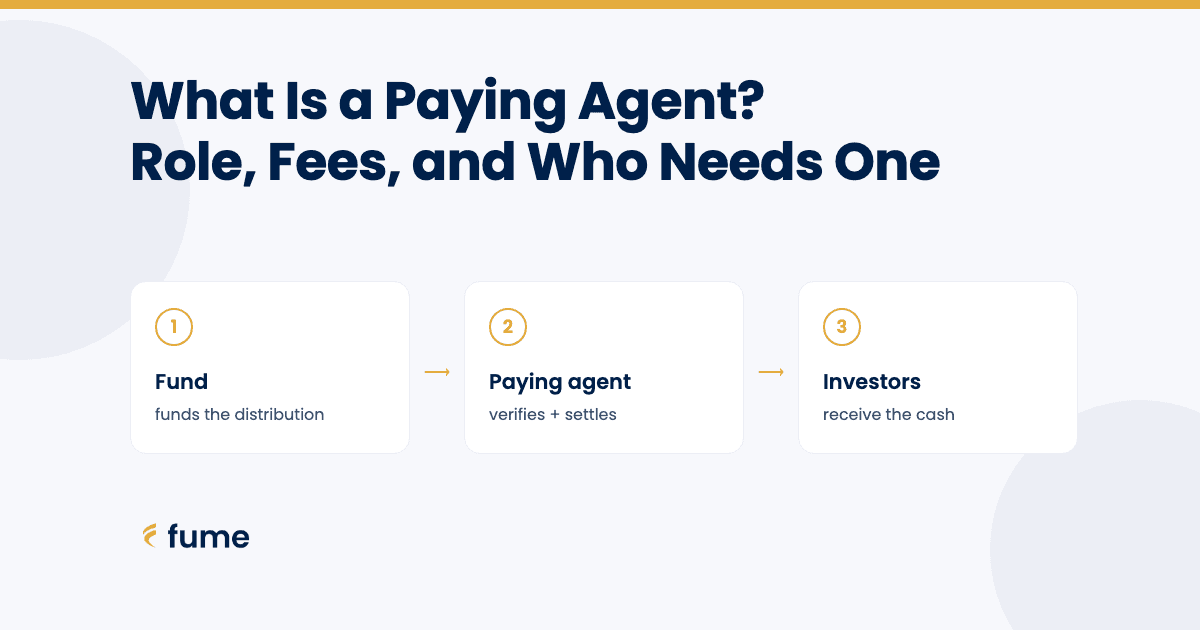
A paying agent is the institution that moves money from a fund or an issuer out to its investors. Dividends, interest coupons, redemption proceeds and capital repayments all pass through it. The paying agent receives the cash from the issuer, checks the payment instruction against the terms of the fund or the note, and settles to each investor's bank account on the due date.
It is a narrow, mechanical role, and that is the point. The paying agent does not decide what to pay or to whom. It executes a distribution that someone else has calculated, and it carries the operational and settlement risk of getting that execution right.
What a paying agent actually does
- Receives the distribution amount from the fund or issuer into a designated account, usually a day or more before the payment date.
- Verifies the payment instruction against the fund documentation, the prospectus or the terms and conditions of the notes.
- Calculates the per-unit or per-note amount where the terms require it, for example an interest coupon on a floating rate note.
- Settles to investors on the due date, either directly to bank accounts or through a clearing system such as Euroclear or Clearstream.
- Handles withholding tax where the jurisdiction requires deduction at source, and issues the supporting documentation.
- Reports the completed distribution back to the issuer, the administrator and, where relevant, the regulator.
In most structures the paying agent is a bank. That is not a stylistic preference: several jurisdictions require it, because the role involves holding and moving client money.
Paying agent vs. transfer agent
These two roles are constantly confused, and the confusion is expensive because the two are appointed under different agreements and priced differently.
| Transfer agent | Paying agent | |
|---|---|---|
| Owns | The investor register | The cash distribution |
| Answers | Who owns how many units | Who gets paid how much, and when |
| Triggered by | Subscriptions, redemptions, transfers | Dividends, coupons, redemption proceeds |
| Typically | An administrator or registrar | A bank |
They meet at redemption. The transfer agent confirms the units are validly held and cancels them; the paying agent sends the money. We covered the full split, including how the two roles interact on a redemption, in the difference between a transfer agent and a paying agent. If you need the register side specifically, start with what a transfer agent is.
Who has to appoint one
There is no single global rule. The requirement comes from three separate places, and a fund can be caught by more than one at once.
The fund's own documentation
Most fund prospectuses and note terms name a paying agent contractually, whether or not a regulator demands it. Once named, the appointment is binding on the fund regardless of what the law would otherwise permit.
The domicile
Luxembourg funds, for example, appoint a paying agent for the settlement of distributions and redemption proceeds, and in practice the depositary bank very often takes the role. Bundling the two is common because the depositary already holds the cash.
The country of distribution
This is the one that surprises managers. Marketing a fund into a new country can trigger a local paying agent requirement independently of where the fund is domiciled. Switzerland is the clearest case: a foreign collective investment scheme offered to non-qualified investors in Switzerland must appoint a Swiss representative and a Swiss paying agent, and the paying agent must be a bank.
Within the EU the direction of travel has been the opposite. The Cross-Border Distribution Directive, applicable from August 2021, removed the requirement for a physical local presence in each host member state. Funds must still make certain facilities available to investors, such as handling subscription and redemption orders and making payments, but they no longer need a local paying agent in every country they market into. If you last checked this before 2021, check it again.
What a paying agent costs
Fee structures are more consistent than fee levels. Almost every paying agent quote is built from the same three components:
- An annual retainer for holding the appointment, payable whether or not you distribute.
- A per-distribution event fee, charged each time a payment run is executed.
- A per-payment or per-investor charge, which is where a fund with many small investors gets expensive.
Cross-border adds a fourth layer. A Swiss representative and paying agent pairing is normally quoted as a combined annual retainer in the mid four to low five figures, before any per-payment charges. Treat any number you read, including that one, as indicative only: pricing moves with investor count, distribution frequency, currencies and the jurisdictions involved.
The structural point is that paying agent cost scales with how often you pay and how many people you pay, not with assets under management. A quarterly distributing fund with 400 investors runs four payment events and 1,600 payments a year. That is the number that drives the invoice.
Where the model breaks
The paying agent role was designed around correspondent banking, and it inherits that system's constraints:
- Settlement is slow. A cross-border distribution can take several business days between the issuer funding the account and the investor seeing the credit.
- Cost scales with headcount. Per-payment pricing punishes exactly the fund that wants a broad, fractional investor base.
- Visibility is poor. Investors typically cannot see where a distribution is until it lands.
- Cut-offs are rigid. Payment runs are batched against banking calendars, not against the fund's own schedule.
Distributions when the register is on-chain
If a fund's units are tokenized, the register is already a smart contract that knows every holder and every balance at any block. A distribution then becomes a payment against that register rather than a file handed to a bank: the contract reads the holder list, splits the distribution pro rata and settles in stablecoin to each holder, in one transaction, with the calculation and the settlement visible to every investor.
Three of the four constraints above go away. Settlement is minutes rather than days, per-payment cost stops scaling with investor count, and investors can verify their own entitlement without asking anyone. What does not go away is the legal question: whether your structure and your distribution jurisdictions permit it, which is a matter for your counsel and your domicile, not for the technology. Our case study comparing a traditional fund with an on-chain fund works through the operational effect on a real vehicle.
Deciding what you need
Three questions settle most cases:
- Does the fund distribute at all? An accumulating fund that never pays out still needs redemption proceeds settled, but the distribution machinery matters much less.
- Where are you marketing? The distribution countries, not the domicile, are what usually trigger a mandatory local appointment.
- How many payments per year? Multiply investors by distribution frequency before you compare quotes. That product, not the retainer, is what you are really buying.
If you are structuring a fund and want to know which agent roles you genuinely have to appoint and which you can automate, book a 30-minute call or write to info@fume.finance. You can also map the full service stack for your own structure with the fund builder.